How Does MTF Bottom Surgery Work? | Gender Confirmation
Medically reviewed by Dr. Zara Ley on January 20, 2026.
MTF Bottom Surgery is an umbrella term that encompasses a variety of gender-affirming genital reconstruction procedures, namely; orchiectomy, vaginoplasty, vulvaplasty and labiaplasty. All three procedures are conducted under general anesthesia, and require support letters from a licensed mental health professional for patients to qualify and receive insurance coverage.
Orchiectomy: How It Works
Orchiectomy is the surgical removal of the testicles. This is a procedure that irreversibly leaves patients infertile. An orchiectomy can be combined with a scrotectomy or the removal of the scrotal pouch skin. Please note that if you are interested in undergoing a vaginoplasty or vulvaplasty, we recommend that you DO NOT undergo a scrotectomy as your scrotal skin will be used to construct the labia majora and labia minora.
Vaginoplasty: How It Works
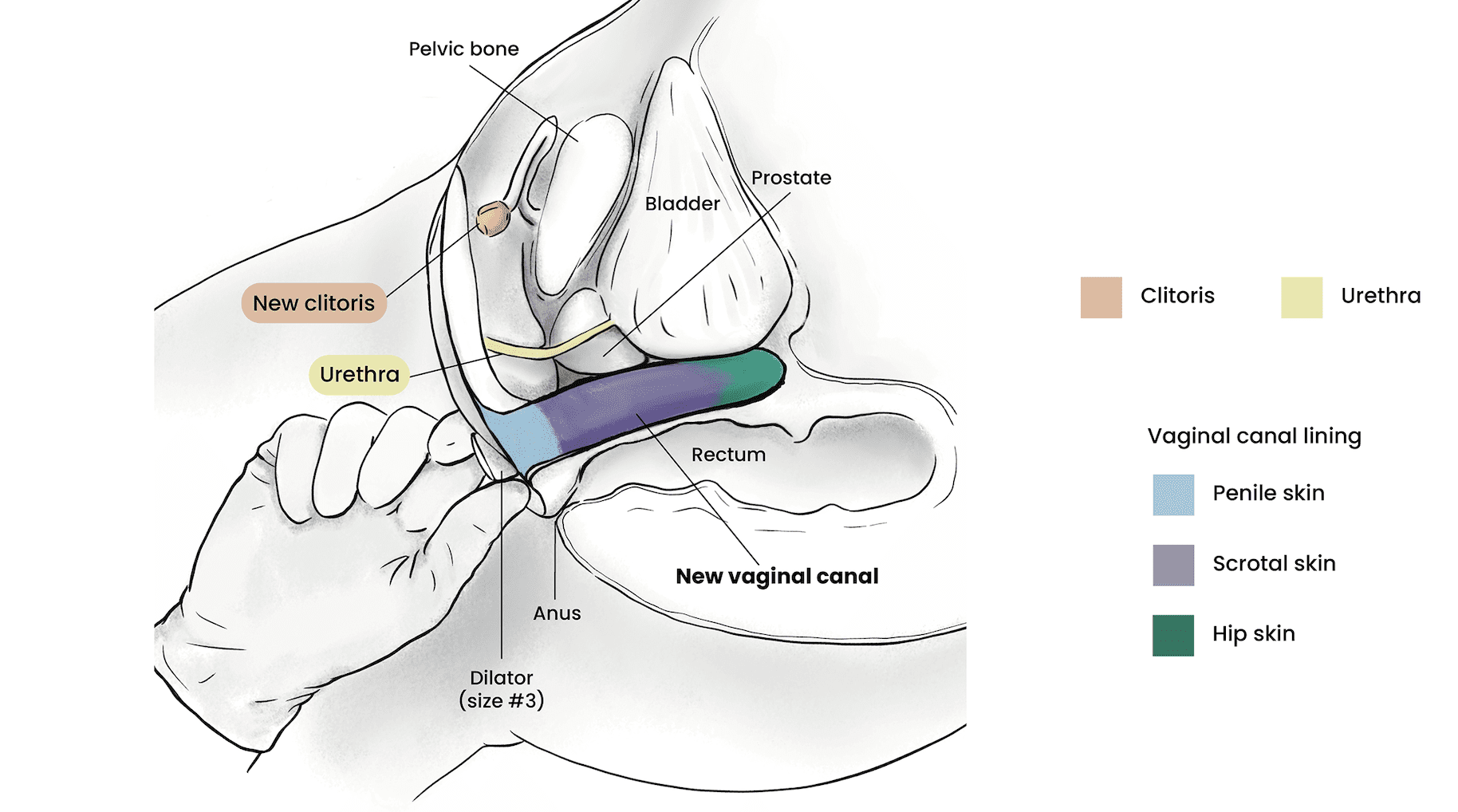
A vaginoplasty involves the complete reconstruction of the internal genitalia (a functional vaginal canal) and external genitalia (a vulva complete with a clitoris, clitoral hood, urethra, and labia). The most common procedure used to create the internal lining of the vaginal wall is the penile-inversion technique, although the internal lining can also be taken from the internal abdominal wall or rectum. At the GCC, Dr. Ley only offers the penile-inversion technique at this time.
Vulvoplasty/Vulvaplasty: How it Works
A vulvaplasty involves the complete reconstruction of the external genitalia to create a vulva complete with a clitoris, clitoral hood, urethra, and labia. Unlike a vaginoplasty, a vaginal canal is not constructed. Instead, patients are left with a dimple at the site of the vaginal opening.
Labiaplasty: How it Works
A labiaplasty reconstructs the vulva to add more defined aesthetic details, such as clitoral hooding, full labia minora, and alterations the overall configuration of the labia majora. A labiaplasty is often the second stage to a vulvaplasty or vaginoplasty. It can also be a revision procedure for patients who are unsatisfied with the configuration of their labia and/or clitoral hood.
 Facebook
 Tweet
Tweet Email
Email