

Which Type of Top Surgery is Right for You?
Medically reviewed by Brianna Smith on April 6, 2026.
Choosing the surgical technique you will undergo is one of the most important steps in your top surgery process. The type of technique you choose will determine your sensory and aesthetic outcomes–including scarring, chest contour, as well as nipple placement and dimensions. In a free consultation at the Gender Confirmation Center (GCC) in San Francisco and Prosilio Care in Pasadena, our board-certified surgeons use proven assessment methods to match patients with the best top surgery incision type for their anatomy and goals. Whether you wish to undergo masculinizing or “FTM” top surgery, or have a more non-binary approach, this guide will help you understand how our expert team makes these decisions with patients.
What Factors Determine Your Top Surgery Options?
Generally speaking, the type of top surgery that is right for you is determined by your anatomy and your unique goals for surgery. During a free virtual or in-person consultation, our surgeons will assess photos you send us of your chest, alongside your medical history, to determine which techniques will be most likely to help us meet your goals in terms of aesthetics and function.
Candidacy Requirements
At the GCC, we do not require that patients undergo hormone replacement surgery (HRT) to be a candidate for surgery. Likewise, most insurance providers do not require patients to be on testosterone HRT to qualify for coverage for gender-affirming top surgery.
Generally speaking, the GCC is one of the few gender-affirming surgical practices that does not discriminate based on body mass index (BMI) to determine top surgery eligibility. That said, patients with a BMI >60 may not receive approval to proceed with surgery from hospital anesthesia departments. This is because of safety concerns and functional limitations around providing adequate air to the lungs during surgery.
Anatomy
We take the following anatomical factors into account when designing your surgical plan:
- Amount of chest tissue and skin: Patients with minimal tissue may be candidates for minimal-scar techniques like keyhole or periareolar. Patients with more tissue and skin to excise often opt for techniques like the double-incision or Inverted-T.
- Skin elasticity: Patients with more elastic skin are more likely to qualify for minimal-scar approaches. Having lesser skin elasticity may require more skin to be excised, leaving more visible scars.
Goals
- Nipple placement and dimensions: Some patients have nipples and areolas whose size and protrusion they would like to reduce. The placement of the nipple-areolar complex on the chest, alongside their dimensions, is oftentimes a consideration that has to do with a patient’s gender presentation and body size. Free nipple grafts allow your surgeon to manipulate their size and location on the chest.
- No nipples: Patients can also opt to have their nipple-areolar complexes removed entirely.
- Nipple sensation goals: Generally speaking, free nipple grafts cause the nipples to lose their sensitivity. If you are interested in preserving the sensitivity of your nipples, you can opt for a technique like the double incision nerve reconstruction (aka. neurotization), Inverted-T, buttonhole, periareolar, keyhole, or lollipop incisions. Patients with a BMI under 30 have an 80% chance of retaining heightened sensation in their nipples post-op with these surgery types.
- Chest contour: Patients have different goals around how flat they would like their chest to look after top surgery. We encourage you to bring in photos of other chests––of top surgery patients or cis men––to give your surgeon an idea of how much volume you would like to retain in your chest.
The Mosser Method: Discovering Your Eligibility with the Inframammary Angle
Many patients ask how they can figure out what incisions will be available to them. Dr. Scott Mosser (he/him)’s tried and true method for determining which types of top surgery his patients are eligible for involves measuring their inframammary angle. The angle is a great way to measure relevant aspects of your anatomy like skin elasticity, amount of chest tissue, and amount of skin overhang, to help you understand which procedures you qualify for.
You might be able to make these observations without taking a photo of your chest, but if you’d like to analyze a photo of yourself, here are some guidelines:
How to Photograph Your Chest for Assessment:
In order to observe and measure the angle of your lower chest tissue area, you will need to take a photo of your chest following these two guidelines:
- The camera must be at the same height as the lower chest. If the photo is either shot from above the chest (looking down at the chest) or below the chest (looking up at the chest), the angle will not be accurate.
- The photo should be taken with the body at a 45-degree angle to the camera. Stand or sit up straight, and face a direction that is 45 degrees (diagonally) off to the side of the camera. This is the only way to capture the profile of the actual chest tissue.
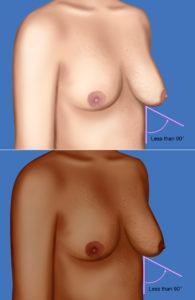
The images above show the type and placement of the angle we are looking for. As you can see, that angle below the chest is clearly visible as long as the person being photographed is facing diagonally relative to the camera.
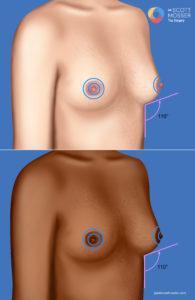
Top Surgery Options by Inframammary Angle
Based on your inframammary angle, you may qualify for the following top surgery incision types:
Inframammary Angle Greater than 135 Degrees
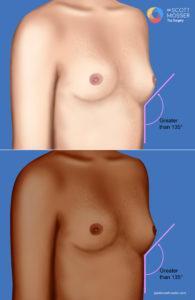
If your inframammary angle––the angle from your torso to the bottom of your mammary tissue––is greater than 135 degrees, you likely have minimal breast tissue and skin overhang. Also, there’s likely not a lot of “projection” (projection means how far the areola & nipple are positioned out forward from the chest due to them sitting on prominent chest tissue). Projection can lead to hanging skin when all of that volume is gone.
Patients that fit into this category often qualify for a keyhole or periareolar top surgery, depending on the amount of skin that would need to be removed.
Glandular Ptosis
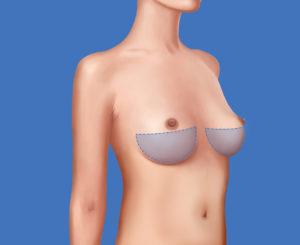
Something for patients considering the periareolar approach to be aware of is glandular ptosis, when the nipple and areola sit high on the chest, or when the area beneath the nipple bulges out beneath the nipple/areolar region, as illustrated to the left with shading.
Because the person depicted in the image has an inframammary angle of less than 90 degrees, they would not be eligible for a periareolar procedure, but the image is provided to illustrate glandular ptosis, which can occur in patients with an inframammary angle of greater than 135 degrees as well.
This circumstance can make the final appearance of a periareolar procedure hard to predict, and sometimes unintended results, like bulges on the lower chest, can occur. Even patients without glandular ptosis can encounter issues with this approach, so it is important to weigh the risks and rewards of the periareolar procedure in order to make an informed decision for your own body.
Inframammary Angle From 110-145 Degrees
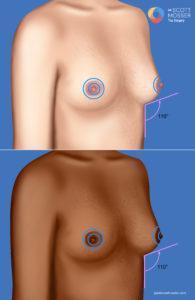
If the angle is about 110 degrees (just a bit wider than a right angle) or more, you are in the middle ground of having too much extra skin for a keyhole incision, but perhaps not so much that a double-incision is necessary. You can consider the following options if you fall into this category:
- Periareolar: For many of these patients, a periareolar (also called circumareolar or purse-string/donut) incision is a possibility.
- Fishmouth: Others with a bit more excess skin may be able to have a donut-type incision with some additional wedges of skin removed nearby the areolas (i.e., the fishmouth incision). However, these approaches may result in either a pleating-pattern of wrinkles around the areolas, or final scars that originate directly out from the areolas.
- Lollipop: An alternative incision for patients in this category is the lollipop technique, which involves an incision around the areola, and a vertical scar running down from it.
- Double-incision: In our practice, some patients in this category ultimately decide to have a double-incision procedure even though other options are available, because the double-incision is the most reliable way to get a flat, tight chest.
Inframammary Angle is Less Than 90 Degrees
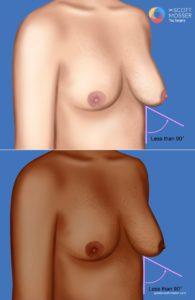
Many top surgery patients have an inframammary angle of less than 90 degree. Virtually all of these patients require extensive skin removal, and therefore will require either a double-incision approach, an inverted-T approach, or the buttonhole approach.
The inverted T and buttonhole techniques are ideal for patients who would like to maintain some volume to their chest and high nipple sensitivity. Patients that would like a completely flat result, but who also want to maintain high levels of nipple sensitivity, can opt for a double incision nerve reconstruction procedure.
Dr. Jacobs’s Approach: The Lying Down Test
Not all surgeons use the same methods when helping a patient figure out which incision type would be best for them. For example, Dr. Jacobs (he/him) uses a simpler method. It involves a patient lying down pre-op to determine if they would be a good candidate for a top surgery procedure that involved minimally scarring. He describes this method more carefully in the video below.
Please note that thanks to new developments in surgical technology, double incision patients can undergo a nerve reconstruction procedure to maintain heightened sensitivity in their nipples.
Additionally, in the clip below, Dr. Jacobs discusses other aesthetic considerations that come into play with choosing which techniques will help you meet your aesthetic goals for top surgery:
Once you have a sense as to which category your body fits into in terms of chest shape and extra skin, you will be able to consider which procedure may be the best option for you.
FAQ
-
 How do I know which top surgery technique is right for me?
 -
To determine which procedure type is best for you, we first assess your anatomy. Your skin elasticity and the amount of tissue you would like to remove will determine the incisions you qualify for. From there, based on your goals–such as nipple resizing, nipple sensation and chest contour–we can make a more precise, unique, surgical plan for you.
-
Can I choose my own top surgery technique?
-
During a free consultation, you and your surgeon will decide together on which procedure would be best for your unique, surgical plan. Your surgeon will likely recommend an incision type based on your anatomy and goals; however, we encourage you to come with your own requests. Our job is to set realistic expectations for what surgery can accomplish for you.
-
Is top surgery covered by insurance?
-
Yes, many insurance providers cover gender-affirming surgery. At the GCC, we have a free insurance concierge team that has a 90% success rate in securing coverage for interested patients.
-
Does top surgery have a specific BMI or age cutoff? Is HRT required?
-
At the GCC, we do not perform surgery on minors. GCC has no HRT or BMI requirements for top surgery. Rather, we evaluate a patient’s medical history to make a unique surgical plan tailored to keeping a patient safe during surgery and reducing their complication risk.
-
What is the most common top surgery technique?
-
The double incision technique is performed more than any other procedure for top surgery. This is because it works for a wide range of chest sizes and gives surgeons the most control over results: specifically, creating flat chests.
Click Here to Request the Next Steps to Schedule a Consult!
We offer complimentary virtual and in-person consultations with our board-certified surgeons. Click here to complete our consultation request form to learn more about the next steps in your patient journey.
BOOK CONSULTATION
Suite 1010, 450 Sutter St
San Francisco, CA 94108
Phone: (415) 780-1515
Fax: (628) 867-6510
GCC business hours are from 9:00 am to 4:00 pm
GCC phone hours are from 9:00 am to 4:00 pm
GCC phone hours are from 9:00 am to 4:00 pm
Board Certification
& Memberships
Copyright © 2023 GCC (Gender Confirmation Center). All Rights Reserved.