


Free Nipple Grafts: Techniques, Risks and Recovery
Medically reviewed by Lin-Lin Liu, PA on September 30, 2026.
The purpose of a free nipple graft is to reconstruct a patient’s nipples and/or areolas. Your surgeon will use skin grafts to alter the dimensions, size and position of the nipple-areolar complex on your chest or breasts. Nipple grafts take approximately six weeks to take hold, and about a year to fully heal.
At the Gender Confirmation Center (GCC) in San Francisco, we offer the most up-to-date techniques: offering patients the chance to re-size both areolas and nipples, and preserve heightened sensation in the nipples if desired. Our surgeons have a 98% success rate in performing free nipple grafts for our top surgery patients. Amongst the few that experience complications, it is extremely rare to lose a considerable portion of a skin graft for any reason, and we have not had a patient completely lose any of the hundreds of skin grafts performed.
You can request a free, remote consultation with one of our board-certified surgeons if you have questions about whether free nipple grafts are right for you.
What is Nipple and Areolar Skin Graft Reconstruction?
The technique was originally developed in reconstructive surgery for breast cancer patients, called a free nipple graft reduction mammoplasty. It has since been adapted to trans masculine patients undergoing gender-affirming chest reconstruction surgery. Amongst this population, several studies have demonstrated this procedure’s safety and effectiveness: postoperative complication rates are low and patient satisfaction rates are high for a variety of grafting techniques.
During an initial gender-affirming top surgery or gynecomastia procedure, most nipple grafts are made from the patient’s original nipples and areolars. They are re-sized and grafted onto the chest in a position most aligned with the patient’s gender embodiment goals. In a revision procedure, your surgeon may take a free skin graft from another part of the body such as the groin.
The Free Nipple Graft Procedure Explained
A classic free nipple graft for top surgery is performed in the following steps:
- Step 1: Preparing the graft. Your nipple-areolar complex is removed from your chest. Your surgeon will resize its dimensions based on the surgical plan you agreed upon in your free consultation.
- Step 2: Placing the graft. Your surgeon will remove the outer layer of skin from the location where the graft is being relocated. This allows us to map out the exact position your nipples will be on your chest. This technique is similar to skinning your knee deeply, but in a much more controlled manner. The skin graft is then placed on the ‘open’ area.
- Step 3: Healing the graft. Immediately after placement, the body starts developing new blood vessels that will grow into the graft. To make sure the graft has solid and continuous contact with the body during this process, the surgeon places a bulky ‘bolster’ dressing on the graft. When the surgeon removes the outer bolster dressing about 1 week after surgery, the grafts are a little bit delicate, but already have a new blood supply. During days 7-21 after surgery, the graft gains a lot of strength, and is quite resilient after 21 days. By 42 days (6 weeks) after surgery, the grafts should be fully healed and usually have the strength of non-grafted tissue.
Alternative Surgical Techniques
The classic free nipple graft technique does not meet every patient’s goals. As a result, our board-certified surgeons offer two alternative techniques for patients:
Sensation Preservation: Nipple Grafts with Neurotization
With the traditional technique, a nipple graft is more like a skin sticker than a normal nipple, as it is disconnected from its original blood and nerve supply. As a result, the nipple’s sensitivity decreases. Once healed, the nipple graft will have a regular, tactile-level sensation like the skin on the upper chest. Many patients are fine with or even enthusiastic for this change. However, for some patients, maintaining a high level of sensitivity in their nipples post-op is a major priority. As a result, we now offer the nerve reconstruction double incision technique to our top surgery patients.
This specific type of top surgery involves preserving the original nerves connected to the nipples. Your surgeon will then perform nerve innervation to connect the nerves to the nipple graft. Nerve healing is a slow process, so patients should expect it to take 6-12 months to recover heightened sensitivity in their nipples after undergoing this procedure.
Resizing both the Nipple and Areolar: Composite Nipple Grafts
A classic nipple graft usually involves reducing the size and shape of just the areola: the pigmented skin around the nipple. However, many patients would also like to reduce the size of their nipples: i.e., the width of their diameter and how far out they protrude. To accomplish this dual reduction of the nipple and areolar, our surgeons offer an innovative technique: the composite nipple graft.
Patients who undergo a composite nipple graft often report doing so in order for their nipple size to be proportional to the new areola size, so that the nipple does not overshadow the areola. Likewise, many patients are interested in having a nipple-areolar complex proportional to the average dimensions of cis men.
With this technique, our surgeons typically aim for a 1.8 to 10 nipple to areola diameter ratio. In other words, the composite nipple graft technique typically results in the creation of a nipple with a 4mm diameter inside of an areola with a 22mm diameter.
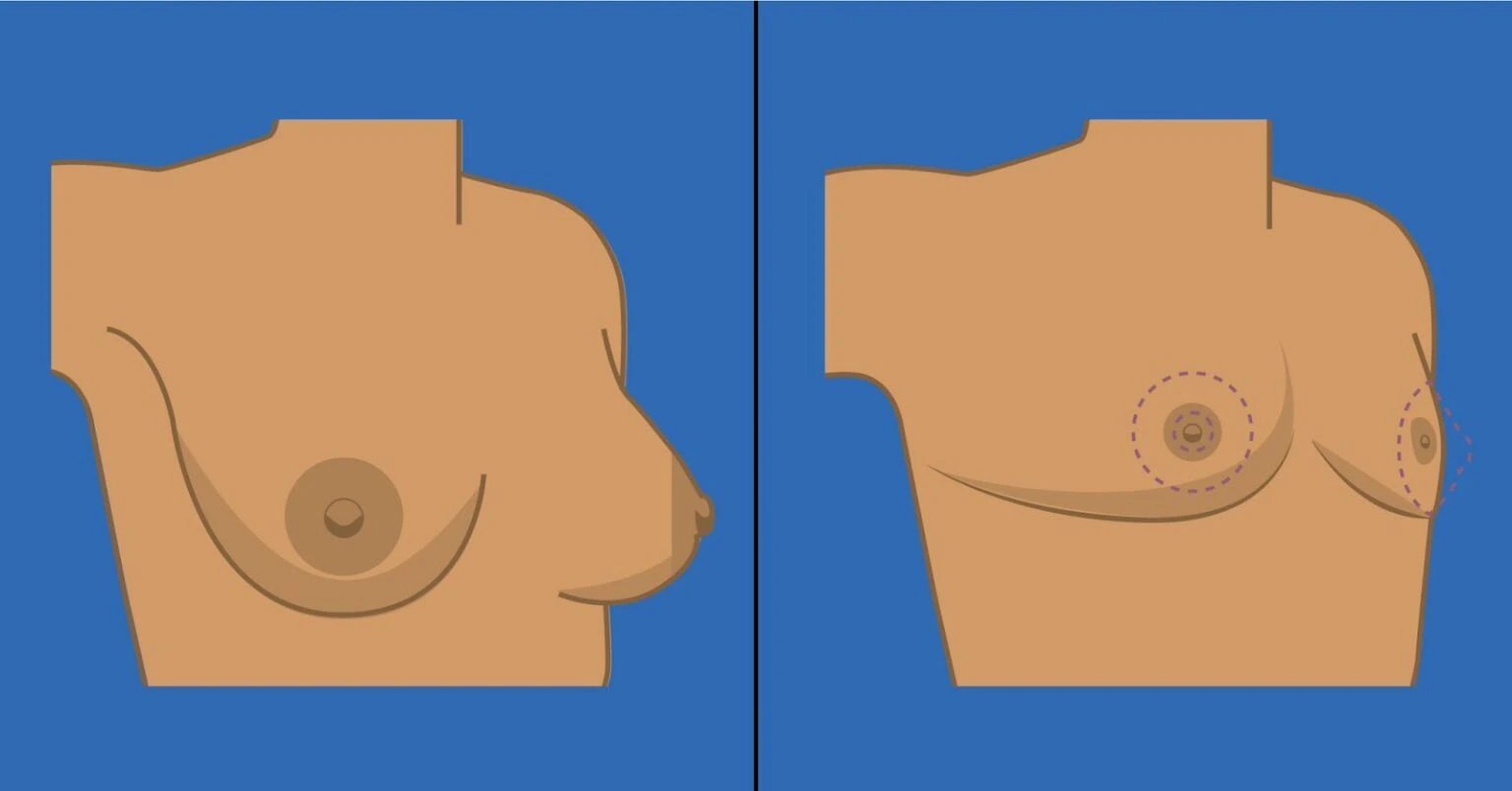
A composite nipple graft can be performed with any top surgery incision type, for either chest reconstruction or breast reduction, making it an option for all eligible top surgery candidates. The technique is composite because it involves two grafts: the areola and nipple are grafted separately, not together. This allows for the nipple to be cut and resized to meet the patient’s goals. The graphic below illustrates what this change can look like:
Request a Consultation to Choose Your Surgical Technique
If you would like to discuss your goals and questions around areola and/or nipple resizing for top surgery, you can request a free, remote consultation here––no commitment required. In a consultation, surgeons will be able to assess your anatomy and medical history to determine what procedure types would be ideal to accomplish your goals. For example, while we are able to offer top surgery to patients with BMIs under 60, patients with a BMI over 30 or those with larger chest sizes often report poorer nipple sensation before and after surgery. Likewise, smoking and tobacco consumption disqualify a patient for undergoing any kind of nerve innervation surgery.
Nipple Graft Healing Timeline & Expectations
The following is a general healing timeline for free nipple grafts. For more specific instructions for the recovery process, click here.
Weeks 1-3:
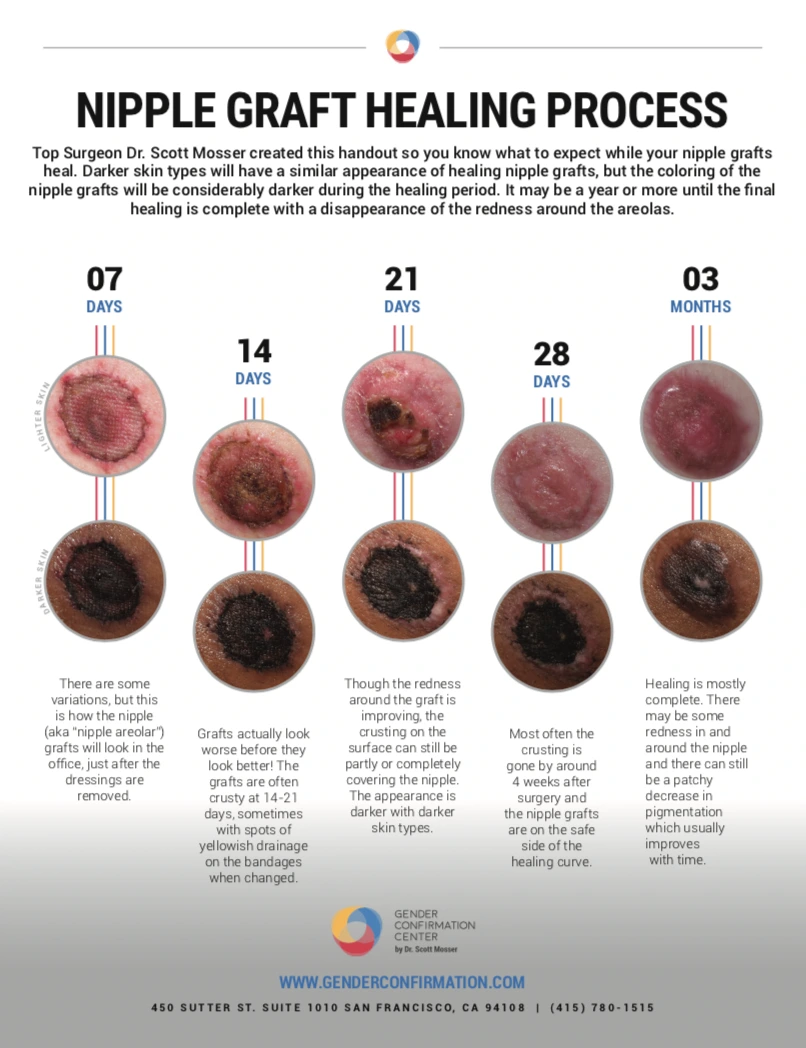
Patients will be discharged with a compressive bolster dressing applied over their nipples. The bolster will be removed at the first postoperative appointment. You will receive instructions for caring for your nipple grafts as they scab up during this time. When nipple grafts heal it is normal for them to look worse before they look better, especially around 14-21 days after surgery.
Weeks 3-6:
It is normal for scabs to start flaking off at around the 3 week mark. There’s no need to panic. Especially when it comes to composite nipple grafts, many patients confuse a scab coming off with the entire nipple falling off. This, however, isn’t the case.
Nipple grafts are most delicate during the first 6 weeks after surgery. During this time, patients must carefully follow the care protocol to ensure that the skin grafts “take hold” to a new blood supply and can survive the rest of healing. Dr. Mosser (he/him) explains this process in the video below:
Long-term Recovery
It takes around a year for nipple grafts to fully heal and for redness around the areolas to disappear. Our surgeons have created a visual breakdown of what most nipples look like from 7 days after top surgery all the way up to 3 months. For a printable version of the nipple healing process pictured below, click here.
Composite Nipple Grafting Healing
Healing protocols for the composite nipple graft are the same as the care instructions for unitary nipple grafts. This technique also carries the same risks around sensation and graft loss as a unitary nipple graft. Many patients who undergo the composite graft will experience nipple scabbing or “slough”. Patients might notice the resized nipples scab up and experience those scabs fall off, especially while showering. This is not a cause for concern as it is a normal part of the healing process. Despite how large the fallen scab tissue may be, it is not an indication that the nipple has fallen off; underneath there will be a new, healing nipple.
Dr. Facque (he/him) discusses care tips for composite and unitary nipple grafts below:
Risks: Threats to Skin Graft Survival
Anything that impairs the ingrowth of blood vessels can impact the survival of a skin graft. The arrival of new blood vessels within a tight time frame, the first few weeks post-op, is an important component of skin graft survival. Although some patients may experience tissue necrosis on their nipple grafts, generally, there’s a low rate of this complication occurring. Still, these are the various issues that can cause a problem:
Bleeding During the Procedure
If the area beneath the skin graft is filled with blood, the blood vessels cannot grow through a collection of blood into the graft. Surgeons do everything they can to control this issue, and the compression bolster helps prevent blood from collecting under the skin graft.
Infection
This is also controlled by the surgeon as well as possible during surgery by using a dose of intra-operative antibiotics and maintaining a sterile operating room.
Smoking:
Smoking can cause issues with blood flow, and so we encourage patients to stop using anything containing nicotine in advance of surgery to ensure your body is able to adequately heal and establish blood flow to the new nipple grafts. Medical conditions, such as uncontrolled diabetes, can cause issues with healing. Your primary care provider can work with you and your surgeon to ensure any conditions you have are well-controlled and will not adversely impact your surgery.
Shear Force.
A “shear force” is a sideways force of one plane being pushed to slide along another plane. Imagine blood vessels slowly making their way into the skin graft. If, at any point, the skin graft is pushed to the side, it would interrupt the ingrowth of those vessels. This would potentially result in failure of the vessels to arrive on time, and therefore failure of the skin graft.
To protect the graft from shear force, during surgery we place a thick dressing on top that securely presses the graft down. This keeps fluid from collecting underneath the graft and protects it from shear forces from the side. A compression garment is often used, since it helps to keep the graft from being bumped to the side––either during sleep or daily activities.
This is also why we instruct patients in the first 3 weeks to avoid sleeping on their side or stomach, and to shower with your back to the showerhead to prevent shear force from the water onto your grafts.
We strongly advise patients to avoid pushing the garment to the side or brushing their chests inadvertently with an arm to avoid creating shear force. In our experience, this leads to 98% of patients having a successful full thickness nipple graft.
Below you’ll find an infographic that spells out the process of nipple graft survival. A PDF image of this diagram can be downloaded here.

FAQ
What should I do before undergoing a nipple skin graft procedure?
We encourage patients to quit smoking, nicotine and tobacco consumption as early as they can. Generally, you will have to stop these habits 3 weeks prior to your operation to be able to undergo surgery. However, quitting beforehand can help you recover as these lifestyle habits are associated with slowed wound healing.
How can I reduce the scars around my nipple grafts?
At your first post-operative appointment, your care team will discuss scar and nipple care instructions. Generally speaking, keeping your scars moist with a scar or silicone ointment, and keeping your scars out of the sun can significantly decrease their visibility as they heal. For some patients, it can take up to a year for the redness around nipple grafts to fully disappear. Likewise, it takes scars 12 months to mature.
What is nipple graft tissue necrosis?
Tissue necrosis occurs when all or a part of your nipple skin graft begins dying off because it does not properly reconnect to a blood supply. This often looks like tissue turning dark brown, blue or black. If we catch tissue necrosis in time, there are treatments we can give patients to help the tissue recover. Some patients may need a revision procedure to correct the necrosis with another skin graft.
Will a nipple graft procedure reduce the sensitivity in my nipples?
Generally speaking, yes. Grafted nipples heal to have a normal, tactile level of sensation like that of the skin on your upper chest. However, patients that undergo a neurotization procedure with their nipple grafts have about an 80% chance of regaining heightened sensation in their nipples post-op.
Click Here to Request the Next Steps to Schedule a Consult!
We offer complimentary virtual and in-person consultations with our board-certified surgeons. Click here to complete our consultation request form to learn more about the next steps in your patient journey.
BOOK CONSULTATION


Suite 1010, 450 Sutter St
San Francisco, CA 94108
Phone: (415) 780-1515
Fax: (628) 867-6510
GCC business hours are from 9:00 am to 4:00 pm
GCC phone hours are from 9:00 am to 4:00 pm
GCC phone hours are from 9:00 am to 4:00 pm
Board Certification
& Memberships


Copyright © 2026 GCC (Gender Confirmation Center). All Rights Reserved.